


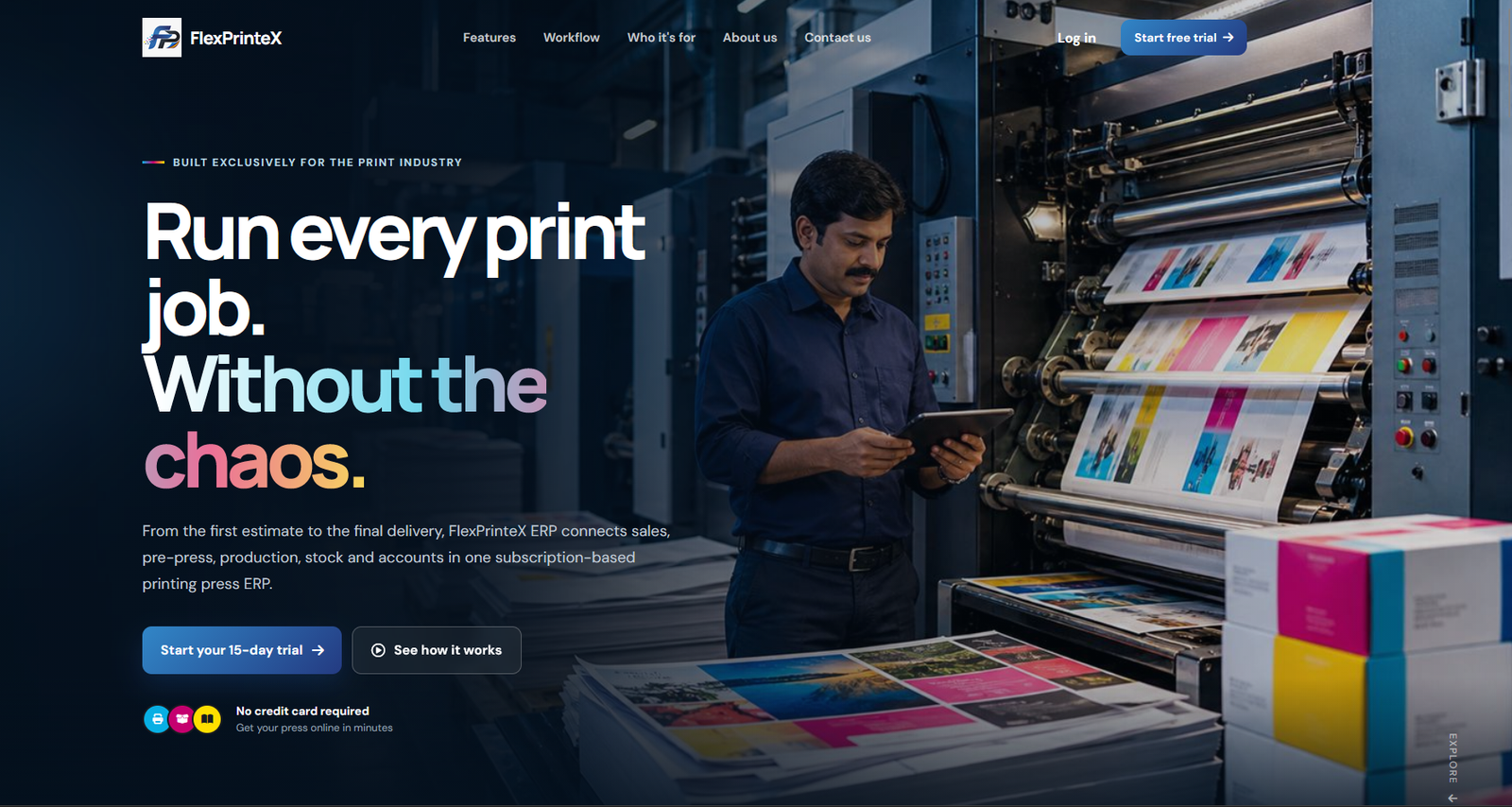
Project Overview
FlexPrintEx was created to solve a practical problem faced by modern printing presses: essential business information is often spread across spreadsheets, paper job cards, messaging apps, and disconnected accounting tools. This fragmentation makes it difficult to estimate jobs consistently, track production, control stock, coordinate teams, monitor profitability, and collect outstanding payments.
I designed and developed FlexPrintEx as an end-to-end operating platform for offset printers, digital print shops, flex and large-format businesses, packaging presses, and commercial printing companies. It connects the complete workflow—from an initial lead and quotation to production, delivery, invoicing, payment, and management reporting—while maintaining a clear record of each operational and financial activity.
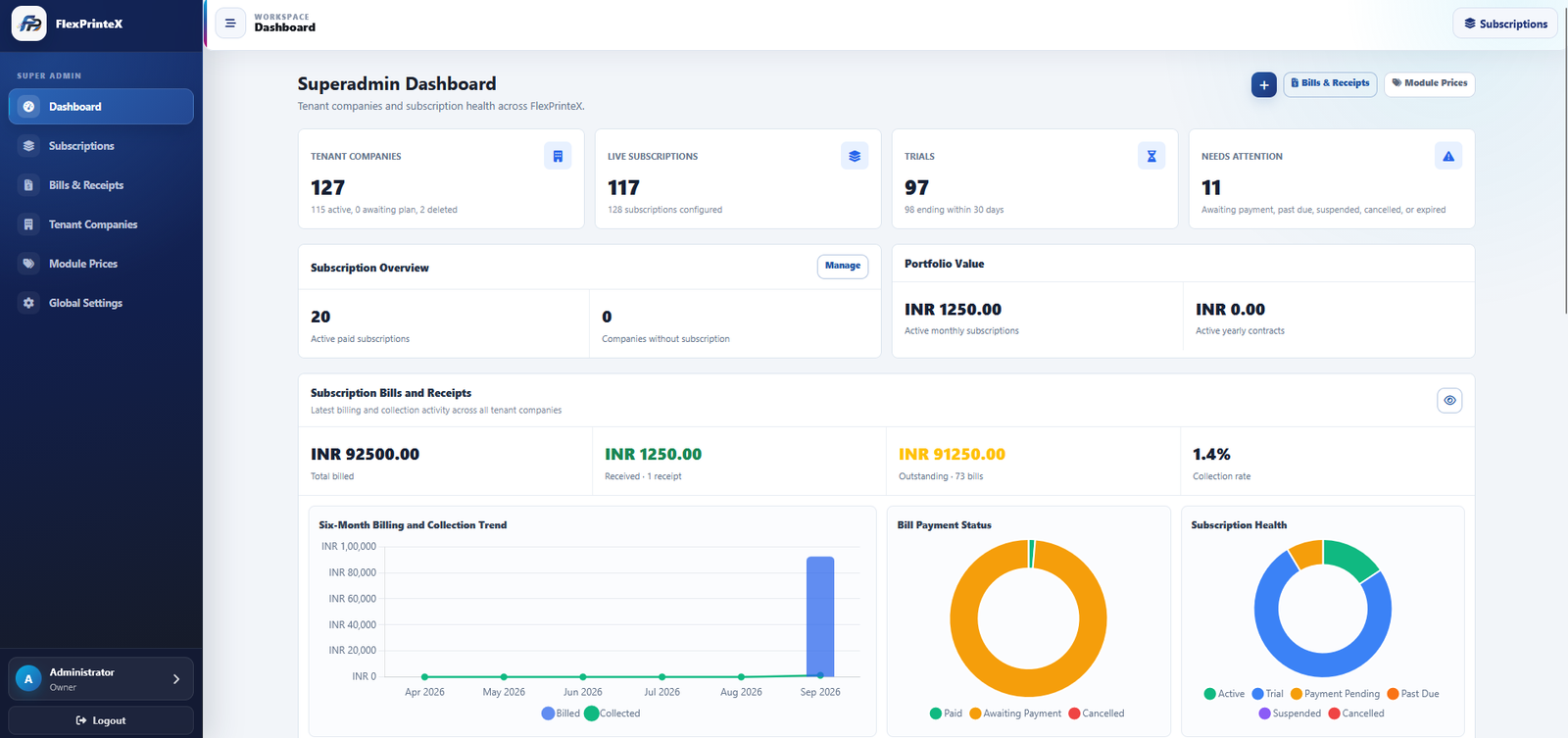
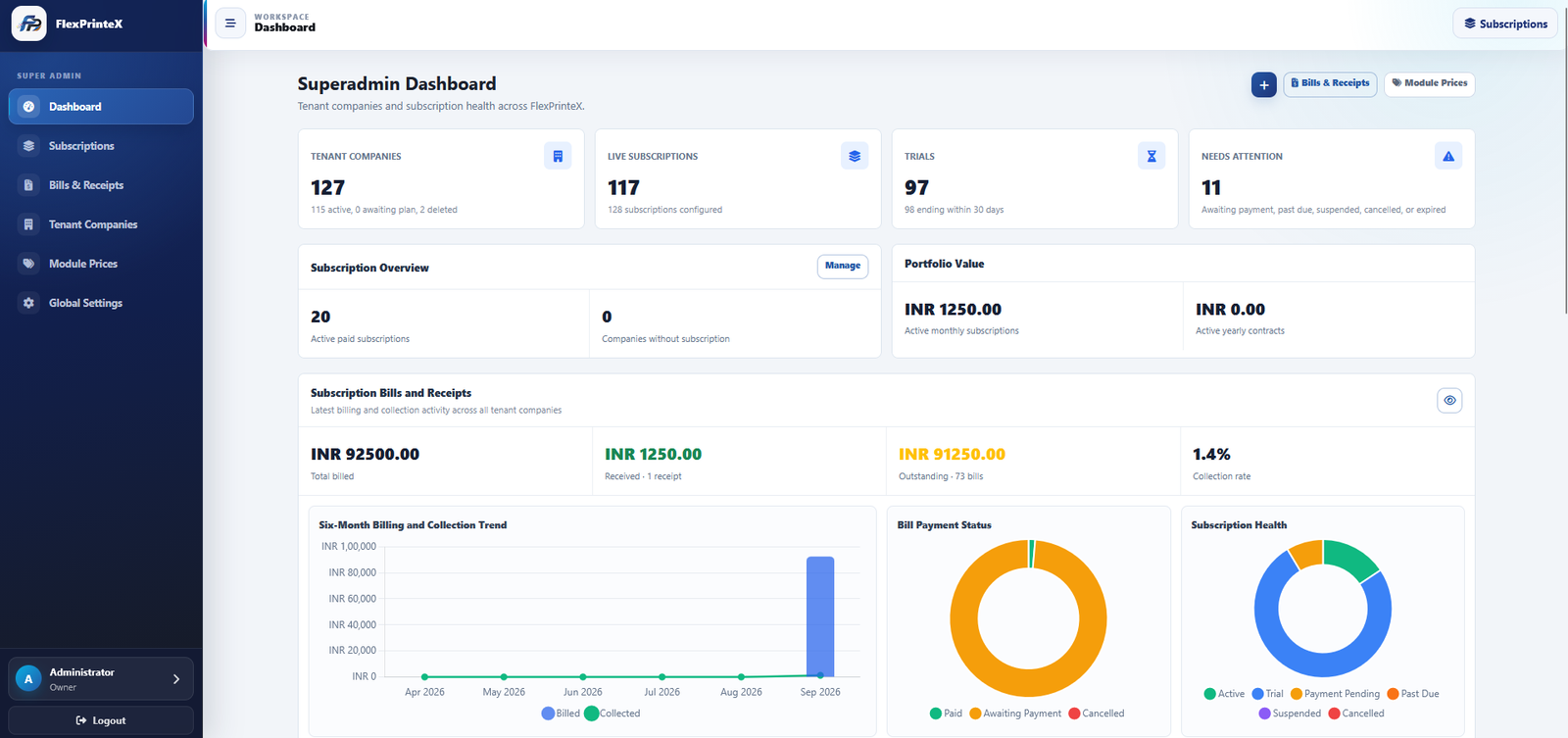
The platform uses a SaaS-ready, multi-tenant architecture. A business owner can manage multiple companies, switch securely between company workspaces, add staff, assign granular permissions, and subscribe only to the modules required by the business. Each company’s operational data and configuration remain isolated, while a super-administration layer manages tenant onboarding, trials, subscription packages, module pricing, billing, renewals, and audit history.
FlexPrintEx is more than a standard invoicing application. It models printing-specific workflows, including print estimation, customer-specific rates, detailed job cards, designer and operator stages, machine-oriented production tracking, media and ink inventory, wastage, outsourced work, supplier purchasing, delivery challans, and job-margin analysis. Automation capabilities extend the system with WhatsApp communication, voice payment reminders, email notifications, reorder reminders, online payments, lead ingestion, and an AI-assisted ERP experience.
Key Features
Multi-Company and Subscription Management
- Multi-tenant company workspaces with secure company switching and isolated business data.
- Owner, administrator, manager, designer, operator, and staff access levels.
- Modular monthly and yearly subscription plans with server-enforced dependencies.
- Self-service tenant registration, email verification, free-trial activation, billing, renewal, and payment flows.
- Super-admin tools for tenant management, module pricing, subscription activation, cancellation, renewal, invoices, receipts, and audit history.
- Support for linking multiple companies to a subscription according to the purchased company capacity.
CRM, Sales, and Customer Management
- Lead capture and customer relationship management.
- Customer profiles, contact details, balances, rate cards, and transaction context.
- Print-specific quotations with configurable items, sizes, quantities, tax, specifications, and pricing.
- Conversion of approved quotations into invoices and production-ready job cards.
- GST-ready invoices, receipts, customer payment tracking, outstanding balances, and party ledgers.
- Printable document previews with configurable numbering and company branding.
Printing Production Workflow
- Detailed job cards connected to invoice items and customer requirements.
- Dedicated workflow stages for design, flex, digital, offset, general operations, outsourcing, and delivery.
- Live job-status tracking from approval through production and dispatch.
- Machine-focused reporting for flex, digital, and offset work.
- Job purchase-order tracking, production history, delivery stages, and wastage records.
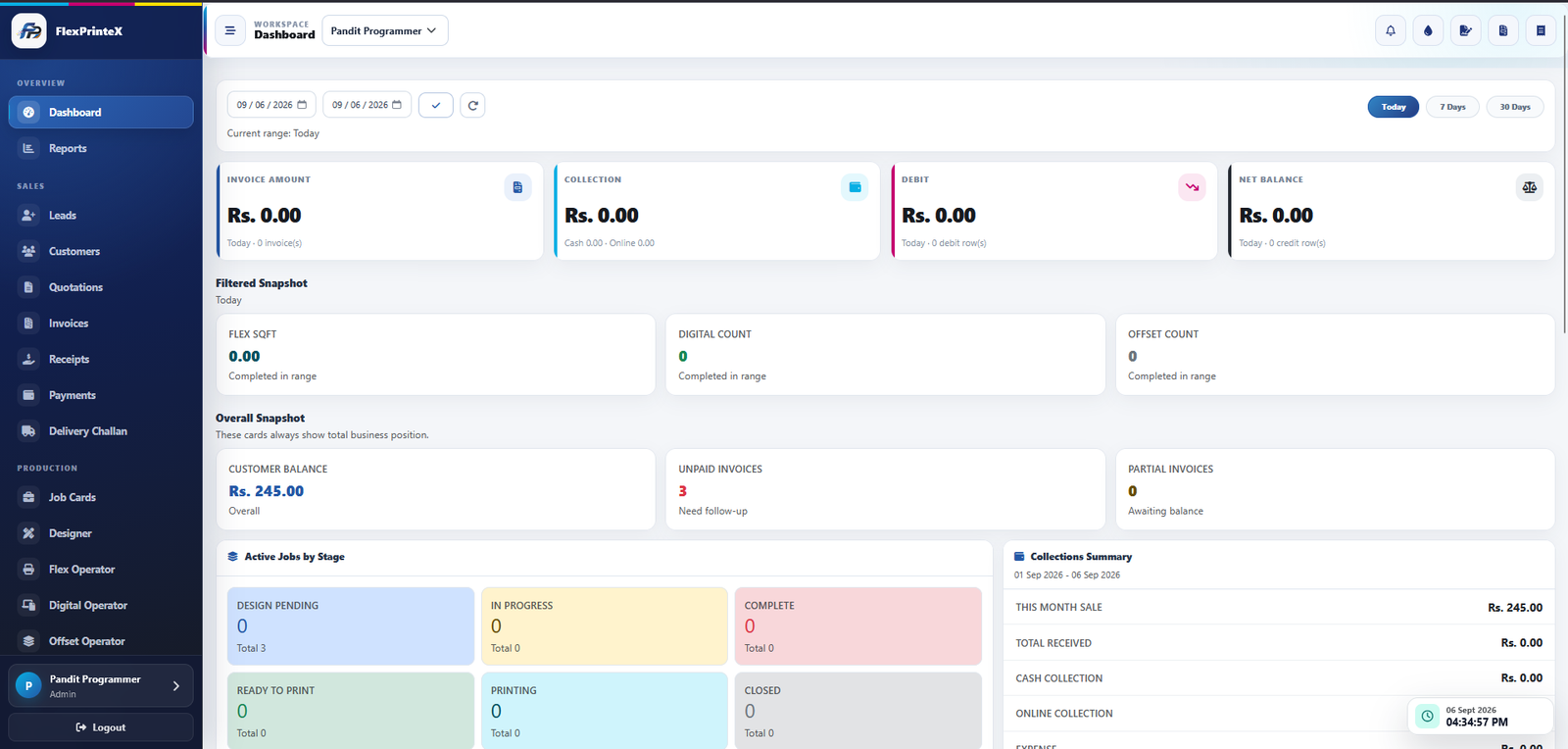
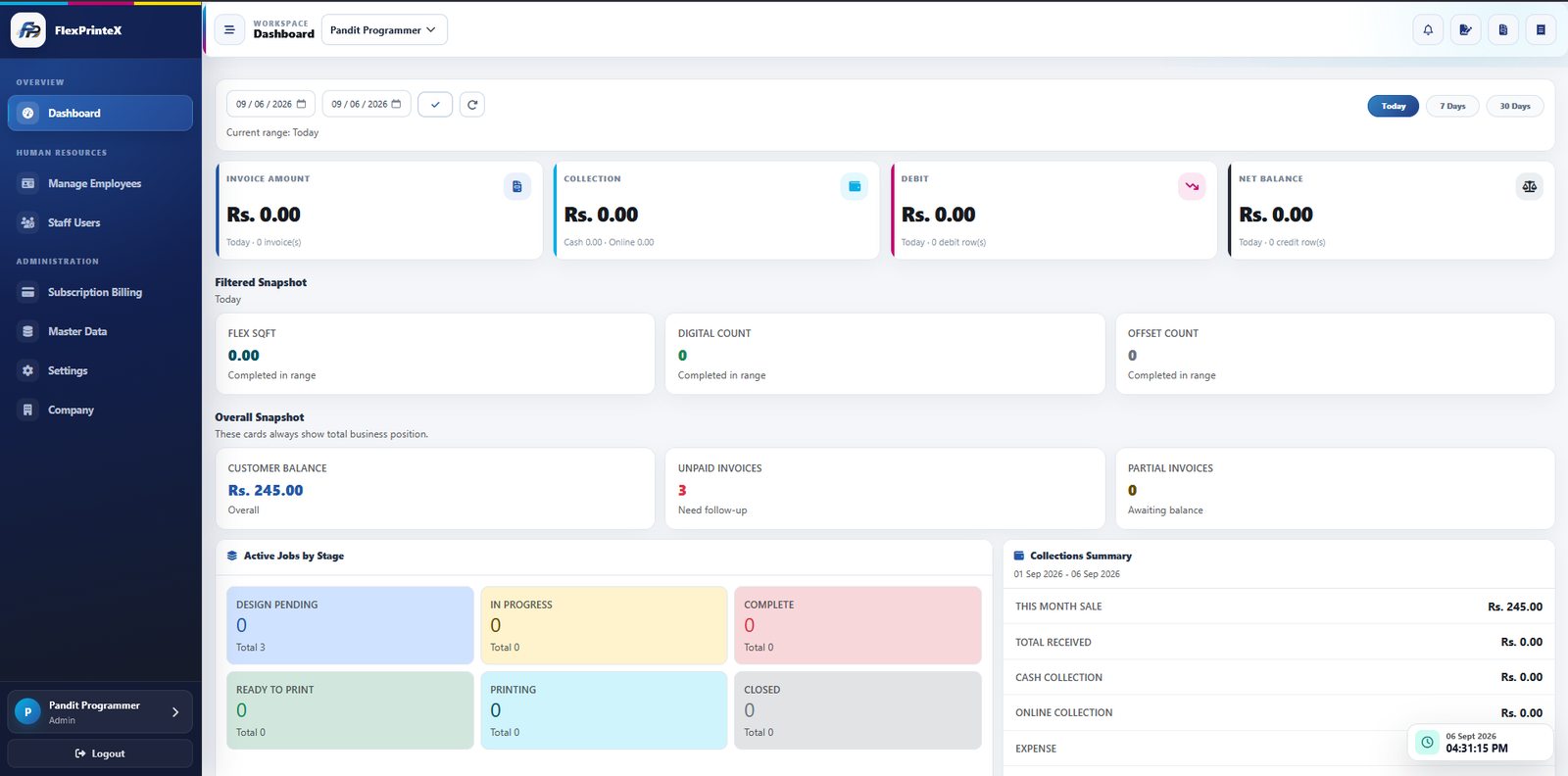
- Visibility into pending tasks and operational priorities through a centralized dashboard.
Inventory, Procurement, and Outsourcing
- Stock ledger for media, paper, ink, rolls, and other production materials.
- Configurable master data for media types, sizes, GSM, units, taxes, HSN codes, products, variants, and rates.
- Low-stock and ink alerts with reminder history.
- Purchase invoices, purchase payments, supplier balances, and purchase orders.
- Outsourced-job management linked to production and financial records.
- Reorder reminders that can be sent through configured communication channels.
Finance and Business Reporting
- Sales invoices, customer receipts, supplier payments, expenses, and transaction history.
- Bank-style transaction reporting and financial document history.
- Income statements, party ledgers, customer and supplier balance reports, and expense reports.
- Invoice-margin, job-card, machine-output, delivery, attendance, payment, purchase, outsourcing, and wastage reports.
- Soft-deletion and history features for traceability and recovery of important business records.
Workforce and Access Control
- Employee master records and staff login management.
- Attendance, work-item assignment, employee payments, adjustments, and payment slips.
- Employee performance points, adjustments, and performance history.
- Fine-grained permissions for viewing, adding, editing, and deleting within individual modules.
- Configurable business-hour login controls and user login audit records.
- Login approval workflows for controlled access where required.
Automation, Communication, and AI
- WhatsApp Business messaging through Meta Cloud API or Twilio.
- Managed WhatsApp templates, approval-status tracking, inbound messages, and a shared inbox.
- Automated payment follow-ups through WhatsApp and configurable Twilio voice calls.
- Email-based registration, profile verification, password-reset OTPs, and operational notifications.
- Scheduled payment, subscription-expiry, renewal, and stock-reorder reminders.
- Meta lead-ad webhook support for bringing enquiries into the ERP.
- Gemini and Dialogflow integrations for AI-assisted conversations and configurable automation.
- ERP AI conversation logs, knowledge history, and company-level AI preferences.
- Razorpay integration for subscription payments and customer invoice-payment portals.
Security
Security was treated as an application-wide concern rather than only a login feature. Key safeguards include:
- Password hashing through Werkzeug instead of storing plaintext credentials.
- CSRF protection across form submissions using Flask-WTF.
- Authentication guards and role-based authorization on protected routes.
- Granular module permissions enforced on the server for view, add, edit, and delete operations.
- Subscription entitlement checks that prevent access to modules outside an active plan, including direct-URL access.
- Tenant-aware query scoping and company-membership validation to keep company data isolated.
- Secure session-based active-company selection with access checks during company switching.
- HMAC signature verification for Razorpay webhooks and signature validation for Twilio callbacks.
- OTP verification using protected digests and constant-time comparisons.
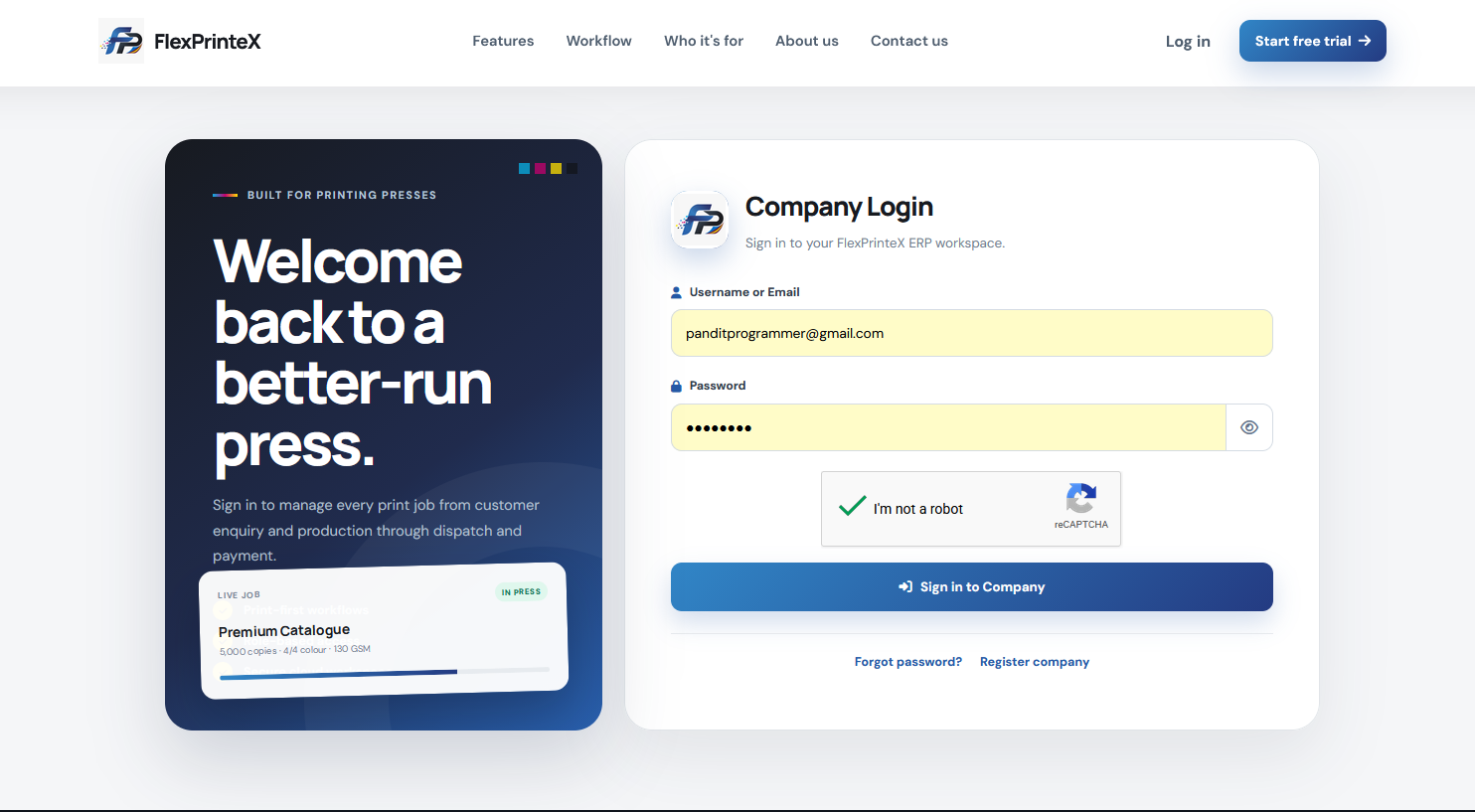
- Optional Google reCAPTCHA protection for public authentication and registration flows.
- Login audit logs, subscription audit logs, document history, and deleted-record tracking.
- Environment-based secret and API configuration, with generated persistent application secrets for local deployments.
- Automated database backup and protected snapshot facilities to improve operational resilience.
Technical Highlights
- Built with Python, Flask, Jinja2, SQLAlchemy, Flask-WTF, HTML5, CSS3, JavaScript, and Bootstrap 5.
- Supports MySQL for production deployments and SQLite for portable local development.
- Organized into modular route and service layers for sales, production, stock, HR, reports, settings, automation, WhatsApp, and AI capabilities.
- Uses a relational domain model covering customers, subscriptions, documents, production jobs, stock, purchasing, workforce activity, communications, and audit data.
- Includes more than 250 route definitions across the complete ERP and public SaaS experience.
- Implements centralized permission and subscription-module catalogues so navigation, endpoints, and commercial entitlements remain consistent.
- Uses dependency resolution for subscription modules, preventing incomplete plans from breaking interconnected workflows.
- Runs scheduled automation through APScheduler with process-aware controls and a scheduler lease to reduce duplicate execution.
- Integrates external services behind configurable company-level and system-level settings with graceful handling when credentials are unavailable.
- Includes reusable document rendering and preview workflows for quotations, invoices, receipts, purchase orders, payment records, delivery challans, and employee slips.
- Designed for VPS deployment with Gunicorn, systemd, Nginx, MySQL, environment-based configuration, and HTTPS support.
- Includes an SEO-focused public product website, structured metadata, responsive layouts, and tenant onboarding pages alongside the authenticated ERP.
Engineering Challenges and Solutions
1. Isolating Data Across Multiple Companies
The most important architectural challenge was ensuring that users could work across authorized companies without exposing one tenant’s records to another. I addressed this with company-aware models, centralized active-company resolution, membership validation, scoped queries, and explicit elevated-query paths for legitimate super-admin operations.
2. Converting a Real Printing Workflow into Software
Printing jobs differ significantly across offset, digital, flex, signage, packaging, and general print work. Instead of forcing every job into a generic product model, I created configurable master data, specialized pricing structures, detailed job specifications, and independent production stages that still participate in one connected workflow.
3. Keeping Sales, Production, Stock, and Finance Synchronized
A single transaction can affect several modules—for example, a quotation may become an invoice and job card, while purchasing and outsourcing can create financial and stock consequences. I built shared service logic and connected domain records so these operations remain traceable and reports reflect the same source data.
4. Combining Permissions with Subscription Entitlements
Staff authorization and customer subscription access are different concerns: a staff member may have permission to use a feature, but the company must also be subscribed to it. FlexPrintEx resolves both layers centrally, expands module dependencies on the server, trims stale permissions, and protects endpoints even when a menu item is hidden.
5. Building Reliable Third-Party Automations
Payment gateways, WhatsApp providers, email services, voice APIs, AI providers, and webhooks all have different credentials and failure modes. I implemented provider-specific validation, signed callback verification, company-level overrides, template management, delivery histories, safe fallbacks, and clear configuration states so external failures do not compromise core ERP operations.
6. Maintaining Traceability Without Blocking Daily Work
ERP users need fast editing and deletion workflows, while business owners need accountability. Document history, deleted-record logs, subscription audit records, login audits, reminder histories, and recovery-oriented features provide traceability without making ordinary workflows unnecessarily complex.
Use Cases
- Offset printing presses: Manage paper, sizes, colors, quotations, plates, job cards, machine stages, wastage, finishing, billing, and dispatch.
- Digital print shops: Move short-run and on-demand jobs quickly from enquiry and artwork to printing, invoicing, and delivery.
- Flex and signage businesses: Calculate dimension-based work, manage rolls and ink, track large-format production, and coordinate installation or delivery.
- Packaging and commercial printers: Maintain repeat specifications, product variants, purchasing, outsourcing, production status, margins, and customer history.
- Multi-branch printing companies: Operate multiple companies under one owner account while keeping staff access, settings, documents, stock, and reports properly separated.
- SaaS operators: Offer a configurable printing ERP through trials and modular subscriptions with centralized pricing, tenant billing, renewals, and audit controls.
- Business owners and managers: Monitor jobs, receivables, stock alerts, expenses, team activity, machine output, and profitability from one dashboard.
Technology Stack
| Layer | Technologies |
|---|---|
| Backend | Python, Flask, SQLAlchemy, Jinja2, Werkzeug |
| Frontend | HTML5, CSS3, JavaScript, Bootstrap 5, Font Awesome |
| Database | MySQL, SQLite |
| Security | Flask-WTF CSRF, hashed passwords, RBAC, tenant scoping, OTP verification, HMAC webhook validation, reCAPTCHA |
| Automation | APScheduler, background services, configurable reminder rules |
| Communication | Meta WhatsApp Cloud API, Twilio WhatsApp and Voice, SMTP email |
| Payments | Razorpay payment links, callbacks, and webhooks |
| AI | Google Gemini, Dialogflow, configurable ERP assistant workflows |
| Deployment | Gunicorn, systemd, Nginx, VPS, environment-based configuration |
My Role
I independently designed and developed the project, including its database architecture, backend services, user interface, printing-specific business workflows, multi-tenant subscription system, access-control model, automation engine, external integrations, reporting modules, deployment configuration, and ongoing feature evolution.
Project Summary
FlexPrintEx demonstrates my ability to transform a complex, industry-specific workflow into a secure and maintainable full-stack product. The project combines ERP engineering, SaaS tenancy, subscription billing, granular authorization, workflow automation, communication APIs, payment integration, AI capabilities, responsive UI development, reporting, and production deployment in one cohesive platform.
Its central value is simple: printing businesses can replace scattered tools with one reliable source of truth—from the first customer enquiry to the final payment—while gaining the visibility, automation, and control needed to operate more efficiently and scale confidently.
Project Information
- Project Name: FlexPrintEx
- Category: SaaS, Enterprise Resource Planning, Print Management Software
- Platform: Responsive Web Application
- Industry: Printing, Packaging, Signage, and Commercial Print Production
- Development Role: Independent Full-Stack Developer
- Project Website: https://flexprintex.com
- Status: Actively developed
Project Information
- Owner : FlexPrintEx
- Category : ERP Web Application
- Project URL : https://flexprintex.com
- Published :